document.querySelectorAll('.menu a').forEach(link => { link.addEventListener('click', () => { var navbar = document.getElementById("navbar"); if (navbar.classList.contains('responsive')) { navbar.classList.remove('responsive'); } }); });

DNA methylation

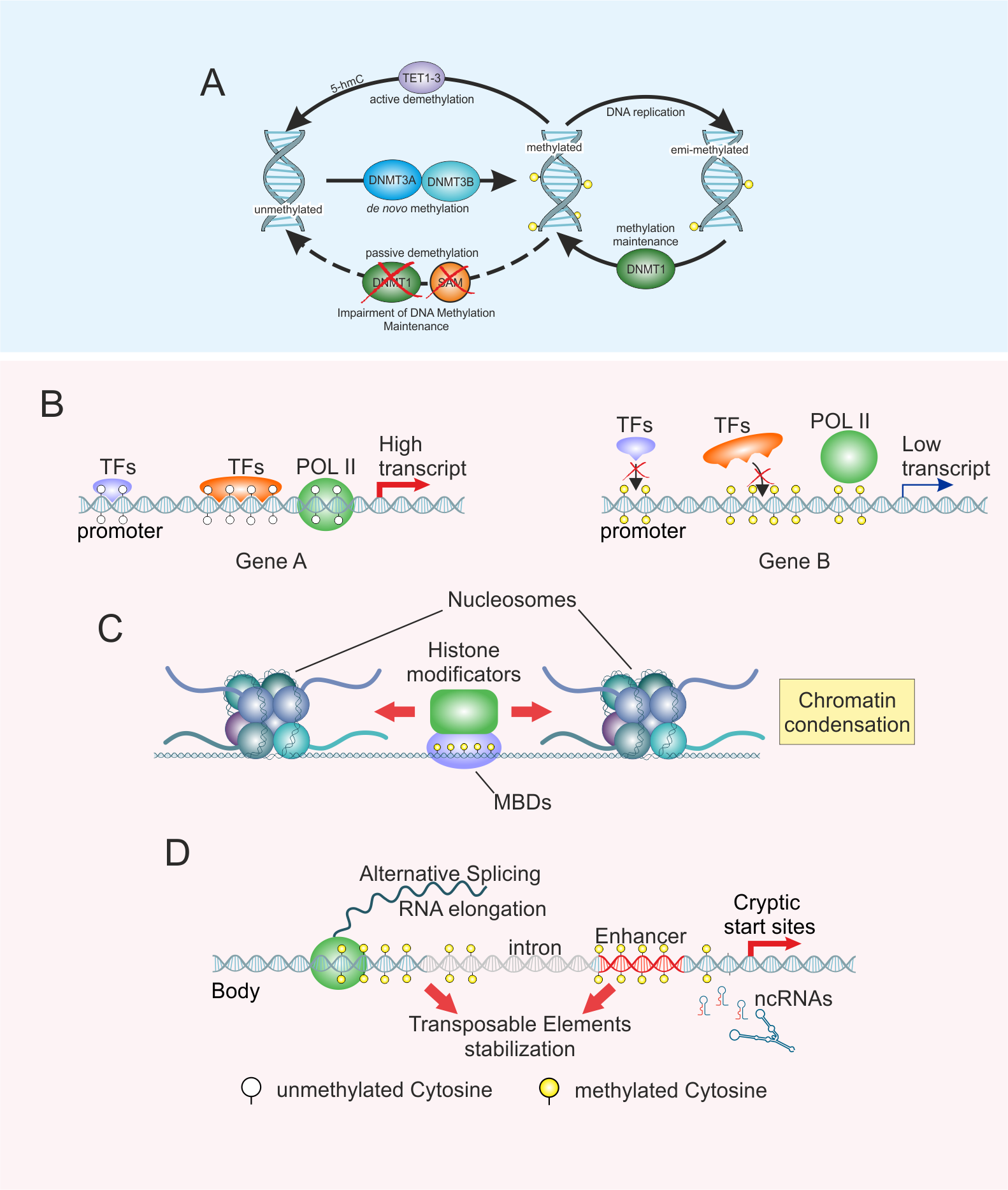
DNA methylation (methDNA) is one of the most well-characterized epigenetic mechanisms, involving the enzymatic transfer of a methyl group to the C5 position of cytosine within the cytosine-guanine (CpG) dinucleotide for the formation of 5-methylcytosine (5mC). This DNA modification is catalyzed by the DNA methyltransferase (DNMT) enzymes, of which DNMT1 maintains the existing methylation patterns across DNA replication, whereas DNMT3A and DNMT3B establish de novo methylation patterns both in physiological and pathological conditions. Conversely, DNA demethylation is mediated by Ten-eleven translocation (TET) dioxygenases, which are involved in active demethylation by catalyzing the sequential oxidation of 5mC into 5-hydroxymethylcytosine (5hmC), 5-formylcytosine (5fC), and 5-carboxylcytosine (5caC). Passive demethylation may also occur during DNA replication if DNMT1 fails to restore methylation marks on the newly synthesized strand (Figure 1A).
Under physiological conditions, methDNA plays a crucial role in regulating numerous biological processes, including parental allele-specific expression of imprinted genes, X-chromosome inactivation, and the maintenance of genome stability and integrity by suppressing the activity of transposable elements.
However, alterations of methDNA status represent one of the most critical epigenetic aberrations involved in pathological conditions, including cancer. Promoter hypomethylation is generally associated with oncogene activation and activation of transposable elements, leading to molecular signaling pathways dysregulation and DNA instability (Figure 1B). Conversely, promoter hypermethylation leads to transcriptional silencing of tumor suppressor genes by interfering with the assembly of the transcriptional machinery at the transcription start site (Figure 1B and C). Intragenic methDNA is also actively involved in the gene expression regulation. Actively transcribed genes typically exhibit body hypermethylation, which prevents spurious transcription initiation and enhances transcription elongation. Furthermore, intragenic methylation can regulate alternative splicing, enhancer activity, DNA replication timing, and tissue-specific reprogramming (Figure 1D).
The recent advances in High-throughput DNA methylation analysis enables the identification of an increasing number of differentially methylated regions (DMRs) as potential diagnostic and prognostic biomarkers. In this context, the development of bioinformatic approaches for the analysis of large-scale methDNA data has become a current necessity. These methodologies are also essential for enabling the integration of methylation data with other omics data, including transcriptomics and genomics as well as with clinical and pathological conditions.
The Figure 1 was adapted from Recent advances on gene-related DNA methylation in cancer diagnosis, prognosis, and treatment: a clinical perspective
DNA methylation illustration

EpiMethEx 2.0 package

EpiMethEx 2.0 (Epigenetics Methylation Expression 2.0) is an R-based bioinformatic pipeline developed for the identification of both intragenic and intergenic DMRs using large-scale methDNA datasets.
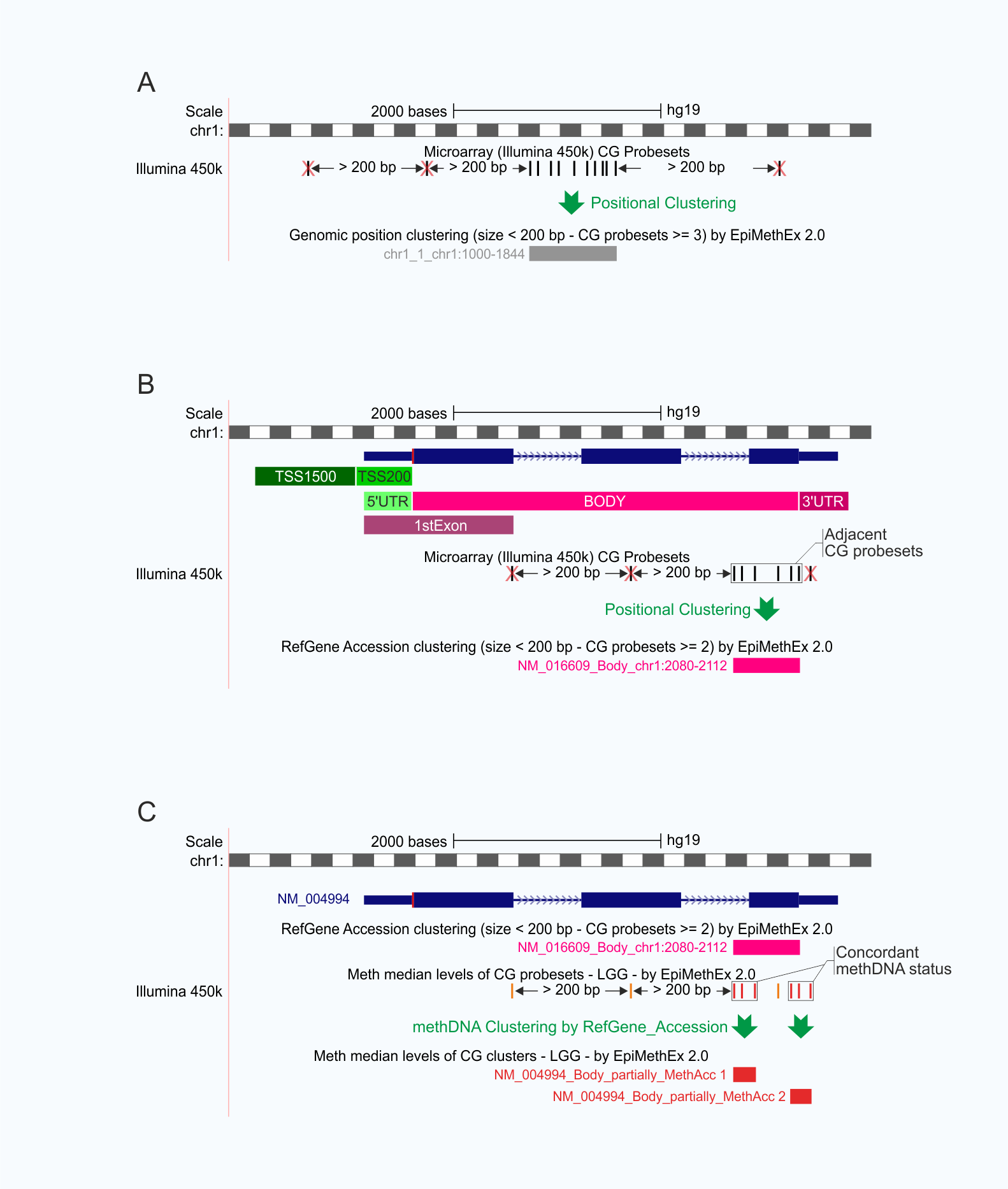
The EpiMethEx 2.0, an improved version of our previous R-package EpiMethEx, is designed to perform clustering analysis of adjacent CG probesets (distance ≤ 200 bp, by default) based on their genomicPosition, RefGene_Name, and RefGene_Accession Annotations, as retrieved from Illumina HumanMethylation450 v1.2 Manifest (Figure 2A and 2B). The resulting positional CG clusters are subsequently used for additional clustering procedures according to concordant values of methDNA, Beta difference (Betadiff) between the comparison groups, and Correlation (Corr) values between methDNA status of each CG probeset and the expression levels of associated genes as follows:
methDNA CG clusters (Hypermethylated CG clusters: median methylation values > 0.6; Partially methylated CG clusters: 0.2 ≤ median methylation values ≤ 0.6; Hypomethylated CG clusters: median methylation values < 0.2);
Betadiff CG clusters (Weakly methylated CG clusters: 0.1 ≤ median beta value < 0.5; Strongly methylated CG clusters: median beta value ≥ 0.5; Weakly demethylated CG clusters: -0.1 ≤ median beta value > -0.5; Strongly demethylated CG clusters: median beta value ≤ -0.5);
Corr CG clusters (Weakly positively correlated CG clusters: 0 < r > 0.3; Moderately positively correlated CG clusters: 0.3 ≤ r ≥ 0.7; Strongly positively correlated CG clusters: r > 0.7; Weakly negatively correlated CG clusters: -0.3 ≤ r < 0; Moderately negatively correlated CG clusters: -0.7 ≤ r < -0.3; Strongly negatively correlated CG clusters: r < -0.7).
EpiMethEx 2.0 scripts also enable a comprehensive analysis by clustering the CG probesets of identified DMRs, here indicated as CG clusters, sharing concordant values of methDNA, Betadiff, and Corr, to generate Integrated CG clusters (Figure 2C).
The scalable and open-source EpiMethEx 2.0 tool can be used for multilevel analyses of different methDNA and gene expression datasets, not only in cancer research but also for investigations in physiological and other pathological conditions. Moreover, EpiMethEx 2.0 package can be employed for comparisons between two or more groups, as well as for sample-by-sample analysis within the same group.
The Figure 2 was adapted from EpiMethEx: a tool for large-scale integrated analysis in methylation hotspots linked to genetic regulation.
EpiMethEx tool

EpiMethEx 2.0 analysis of TCGA tumors

The EpiMethEx 2.0 package was used to analyze methDNA and expression datasets (DNA methylation - Methylation450k and TCGA RNAseq - IlluminaHiSeq pancan normalized datasets, respectively) retrieved from 33 TCGA tumor types and the associated Normal Pool cohort.
Clustering analysis of consecutive CG probesets was first performed based on their genomicPosition (CG clusters = 23,392; CG probesets ≥ 3; distance ≤ 200 bp), RefGene_Name (CG clusters = 38,777; CG probesets ≥ 2; distance ≤ 200 bp), and RefGene_Accession (CG clusters = 132,316; CG probesets ≥ 2; distance ≤ 200 bp), using annotations from Illumina Manifest.
Starting from the identified positional CG clusters, methDNA clustering analysis allowed to identify DMRs that exhibited similar methylation patterns across various tumor types compared to the Normal Pool cohort, as well as tumor-specific DMRs. The methDNA clustering analysis also enabled the selection of exclusively methylated (MAX) and exclusively demethylated (MIN) CG clusters for each TCGA tumor type compared to both other tumors and the Normal Pool.
Betadiff clustering analysis in TCGA tumors led to the identification of strongly methylated (median Betadiff value > 0.5) and strongly demethylated (median Betadiff value < -0.5) CG clusters for each TCGA tumor than the Normal Pool.
Corr CG clustering analysis was also performed to identify cancer-related genes that are closely regulated by methDNA in most tumors. Integrated analysis of methDNA and Corr CG clusters, considering their genomic locations and gene expression values, revealed that the majority of hypomethylated and negatively correlated CG clusters (88.8%) were mapped to the promoter regions of their associated genes. Conversely, almost all CG clusters that were both hypermethylated and positively correlated with the expression levels (86.3%) were located within the Body regions. Finally, clustering analysis was performed by merging methDNA, Betadiff, and Corr CG clusters to generate integrated CG clusters. This approach enabled the identification of most relevant DMRs related to key tumor-related genes for each TCGA tumor type.

The datasets used for EpiMethEx 2.0 analyses, along with the results obtained from TCGA datasets, are available here:
Launch EpiMethEx 2.0 on TCGA tumors or Zenodo Dataset Collection

scandido@unict.it

Dept. Biometec - Unict,
Via Santa Sofia, 97, Catania, Italy

+39 095 478 1482